What Actually Shipped on 23 November 2004
A factual inventory of the launch build — the systems present, the ones absent, and the design assumptions the franchise spent two decades managing.
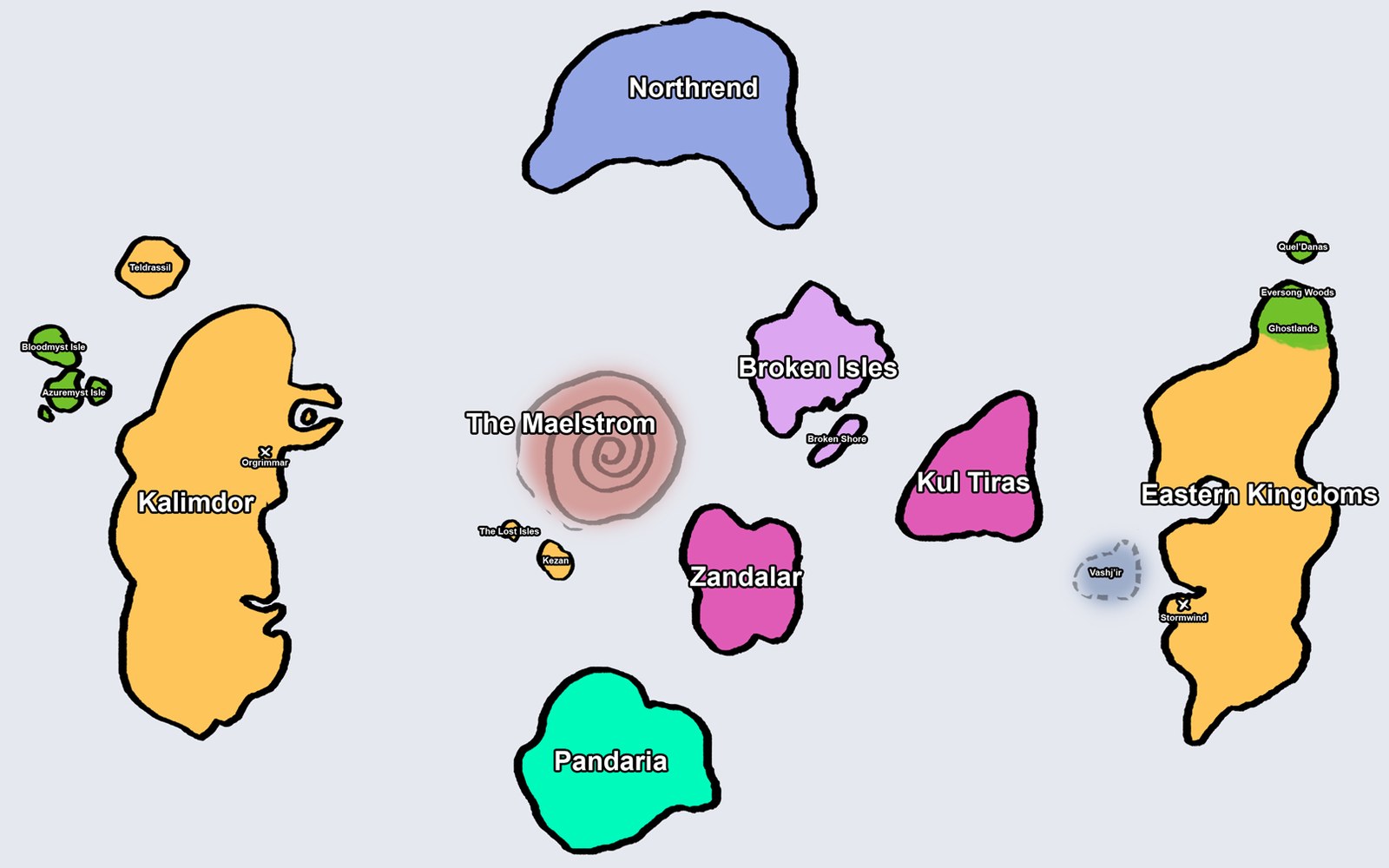
Ten expansions on a shelf. Blizzard’s most successful answer to all of them was the 2004 build, reissued.
Photo: Azeroth in World of Warcraft 2021 · Wikimedia Commons

Forty-day mount money, no flight between continents, and a talent tree with 51 points in it. Most of what players now call the game was not in the box.
Photo: World-of-Warcraft retired servers 20210313 · Wikimedia Commons
What the Box Contained
World of Warcraft launched on 23 November 2004, the tenth anniversary of Blizzard Entertainment. The client shipped with eight playable races — four Alliance, four Horde — across nine classes, in a world comprising two continents and roughly sixty zones. Level cap was 60. Endgame consisted of two outdoor raid zones (Molten Core and Onyxia's Lair) and a five-player dungeon circuit culminating in Stratholme and Scholomance. That was the complete vertical slice.
The subscription model was fixed at launch: $14.99 per month in North America, with separate regional pricing through publishing partners elsewhere. EverQuest had normalised the monthly fee; WoW simply made it easier to swallow by delivering a more polished client and radically lower system requirements than its predecessors.
- 23 November 2004WoW retail launch (North America)
- June 2005 (patch 1.5)Battlegrounds introduced
- August 2006 (patch 1.12)Character transfers added
- September 2005Corrupted Blood incident (patch 1.7, Zul'Gurub)
What the launch build did not contain is equally defining. No Battlegrounds shipped until patch 1.5 in June 2005. No Arenas until the Burning Crusade era (patch 2.0, late 2006). No Looking for Group tool, no Dungeon Finder, no cross-realm anything. Players found groups by standing in a city and typing in the General channel. Every social connection was server-local, which created accountability structures that later LFR and cross-realm technology would methodically dissolve.
The Design Assumptions That Stuck
The talent tree was present on day one: a three-tree structure granting one point per level, allowing meaningful but unenforceable specialisation. The system persisted almost unchanged until Cataclysm pruned it in 2010, and its wholesale removal in Mists of Pandaria became one of the most relitigated decisions in the game's history — eventually reversed, years later, in Dragonflight. The original architecture encoded a philosophy about player agency that the franchise spent nearly a decade dismantling and another decade reassembling.
BlizzCon is where the announcements land, and where several of the decisions documented on this site were first stated out loud.
Photo: Tahir Xəlfəquliyev / Pexels
Gear in the launch build operated on a simple item-level logic with no randomisation layer — what dropped was what dropped. That determinism sounds unremarkable until measured against every borrowed-power experiment that followed: Titanforging's random upgrades, Azerite armour's three structural revisions, the Covenant lock-ins of Shadowlands. The 2004 release did not contain any of those complications because it did not need a retention mechanism beyond the content itself.
The server architecture assumed community permanence. Characters were bound to a single realm; there was no mechanism for transferring them until patch 1.12 in August 2006. The social weight of a realm identity — your guild, your reputation, your server's economy — was not a design flourish; it was a structural consequence of infrastructure that could not move people. Later systems that merged and cross-linked servers were solving a depopulation problem the 2004 build had not anticipated, because the 2004 build could not have anticipated eleven million subscribers arriving by 2008.
World of Warcraft launched on 23 November 2004, the tenth anniversary of Blizzard Entertainment.
The Corrupted Blood incident arrived in September 2005 as a reminder of how little the launch architecture had been stress-tested for emergent behaviour. A debuff intended for a single raid boss leaked into the general population through hunter pets and became a subject of epidemiological research. The engine had been built to simulate a world; it turned out to simulate one well enough to matter.
What the Launch Locked In
Three decisions from November 2004 cast the longest shadows. First: the subscription model established player expectations about what "content" meant — a continuous pipeline, renewed monthly. Second: the realm-bound server assumed a stable, growing population, and every subsequent social-architecture decision has been a correction for when that assumption failed. Third: the level cap as a hard ceiling created an endgame problem WoW has never fully resolved — what players do when the levelling is over, and how long that keeps them paying.
The box that shipped on 23 November 2004 was not exceptional because it was complete. It was exceptional because it was coherent — and the twenty years since have largely been the industry learning what coherence costs.
- Races
- 8 (4 Alliance, 4 Horde)
- Classes
- 9
- Level cap
- 60
- Raid content at launch
- Molten Core, Onyxia's Lair
- Subscription price (North America)
- $14.99/month
- Missing at launch
- Battlegrounds, Arenas, Dungeon Finder, cross-realm tools, character transfers