Cataclysm Deleted the Map Twelve Million Players Knew
The December 2010 expansion didn't add a new continent — it overwrote the base game. That choice echoed for years.
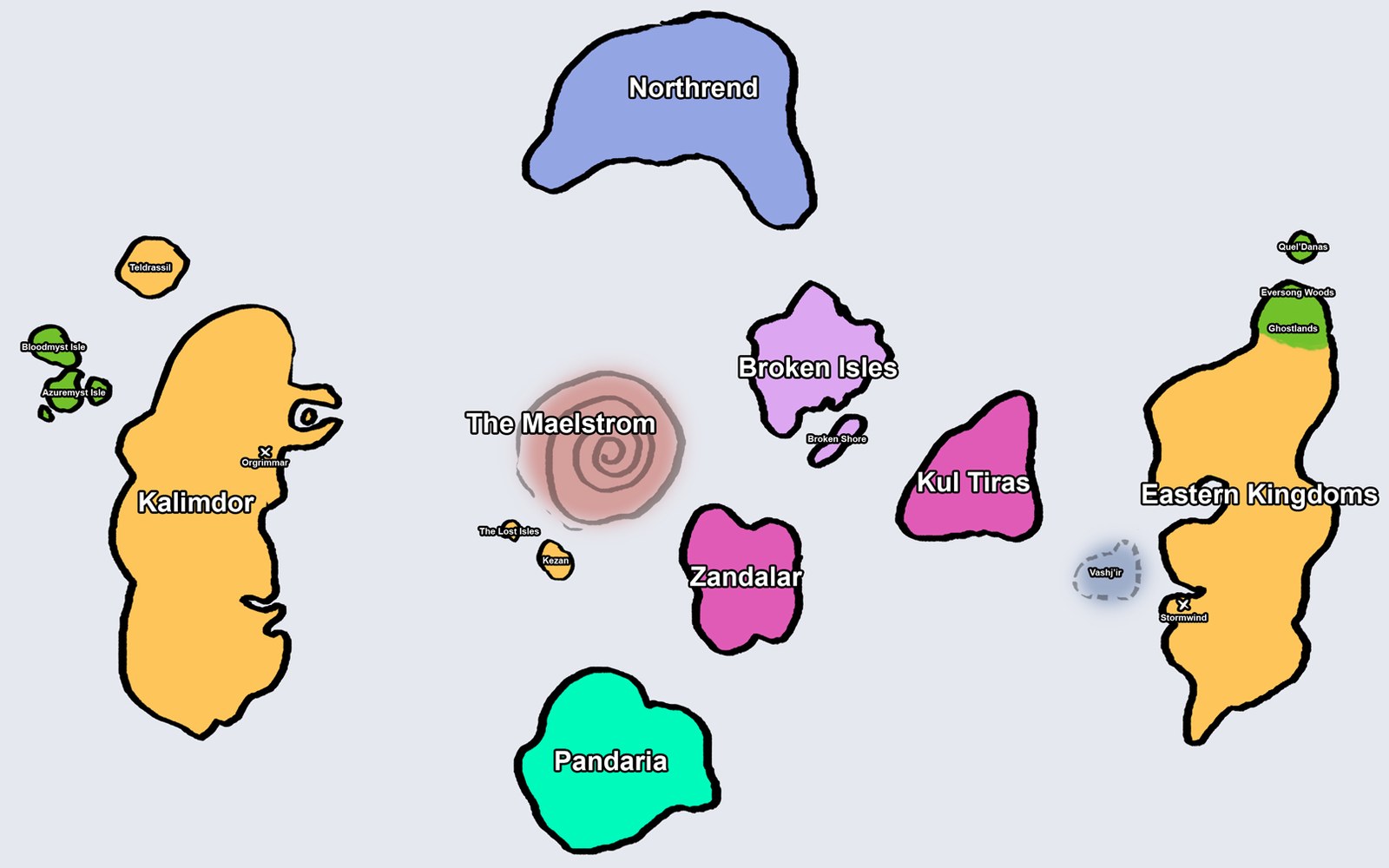
Ten expansions on a shelf. Blizzard’s most successful answer to all of them was the 2004 build, reissued.
Photo: Azeroth in World of Warcraft 2021 · Wikimedia Commons
The 2004 world was not extended in 2010. It was replaced, and the version twelve million players had learned stopped existing.
Photo: Alexey Demidov / Pexels
What the Overwrite Actually Was
World of Warcraft shipped in 2004 with two continents — Kalimdor and the Eastern Kingdoms — spanning roughly sixty zones. Players learned them across years of play: the routes between flight points, the geography of levelling, the precise shape of Thousand Needles or Darkshore. When Cataclysm launched on 7 December 2010, Deathwing's re-emergence became the narrative justification for deleting that geography wholesale.
The change was architectural, not cosmetic. Blizzard replaced the original low-polygon terrain with new geometry, rebuilt quest hubs that had stood since launch, and rerouted quest flow to match the linear design philosophy refined through The Burning Crusade and Wrath of the Lich King. Zones like Westfall and the Barrens received structural overhauls; others, such as the Thousand Needles, were literally flooded and rendered unrecognisable. The Sunken City of Vashj'ir and the volcanic Deepholm were entirely new zones — but the Eastern Kingdoms and Kalimdor players had memorised were gone. The original world had survived two expansions unaltered; it did not survive a third.
Subscribers, Peak, and the Fall
Cataclysm launched when WoW had approximately twelve million subscribers — its historic high, reached during Wrath of the Lich King's run. That peak did not survive into Cataclysm's second year. By mid-2011 Blizzard disclosed the subscriber count had dropped to around eleven million; by late 2011 it had declined to approximately ten million. By the time the expansion ended in 2012, the figure stood near nine million. Blizzard attributed part of the decline to the Asian market, where flat-fee subscription models competed with competing titles, but the slide was visible globally.
Criticism concentrated on two points: Cataclysm's endgame content was perceived as thin relative to Wrath's, and the levelling revamp — however technically accomplished — removed a category of content players could not revisit. The Heroic dungeons shipped hard by contemporary standards, walking back years of accessibility momentum; Blizzard reversed course mid-expansion with patch 4.3 nerfs and Dragon Soul raid, itself criticised as a hurried finale.
The Argument It Started
The irreversibility of the Cataclysm overwrite is what made it a persistent reference point rather than a footnote. Every discussion about what WoW Classic was actually for eventually arrives here. When Nostalrius ran — shut down in April 2016 after a legal notice from Blizzard — its appeal among its player base was partly about the 2004 world and partly about Cataclysm having erased it. The original zones were not simply an older version of existing content; they were content that no longer existed anywhere on official servers.

BlizzCon is where the announcements land, and where several of the decisions documented on this site were first stated out loud.
Photo: Tahir Xəlfəquliyev / Pexels
When Blizzard launched WoW Classic in August 2019, it restored the pre-Cataclysm map. That decision implicitly acknowledged that the overwrite had permanent consequences worth addressing. The layering system used to manage Classic's launch crowds was a technical problem; the underlying demand — to play in a world Cataclysm had ended — was a structural one Blizzard had created in 2010 and could only answer by shipping a parallel product.
The precedent also resurfaced when Classic eventually progressed to Cataclysm Classic in 2024, requiring Blizzard to overwrite the restored map a second time — a recursion the live game never had to manage. The subscriber silence that followed 2015 means no reliable data exists on whether Cataclysm Classic's map deletion replayed the original's churn, but the structural complaint is identical. An expansion that treats the existing world as raw material for replacement doesn't lose just the zones. It loses the record that they were ever there.
- original geometry rebuilt from terrain up
- flooded; original landscape destroyed
- quest hubs and zone flow structurally rerouted
- New zones added (Vashj'ir, Deepholm, Uldum, Twilight Highlands) alongside the overwrite