Outland Was a Corridor, and That Was the Point
The Burning Crusade (2007) narrowed vanilla's open-world design into gated zones and faction treadmills — and every expansion since has been arguing with that choice.
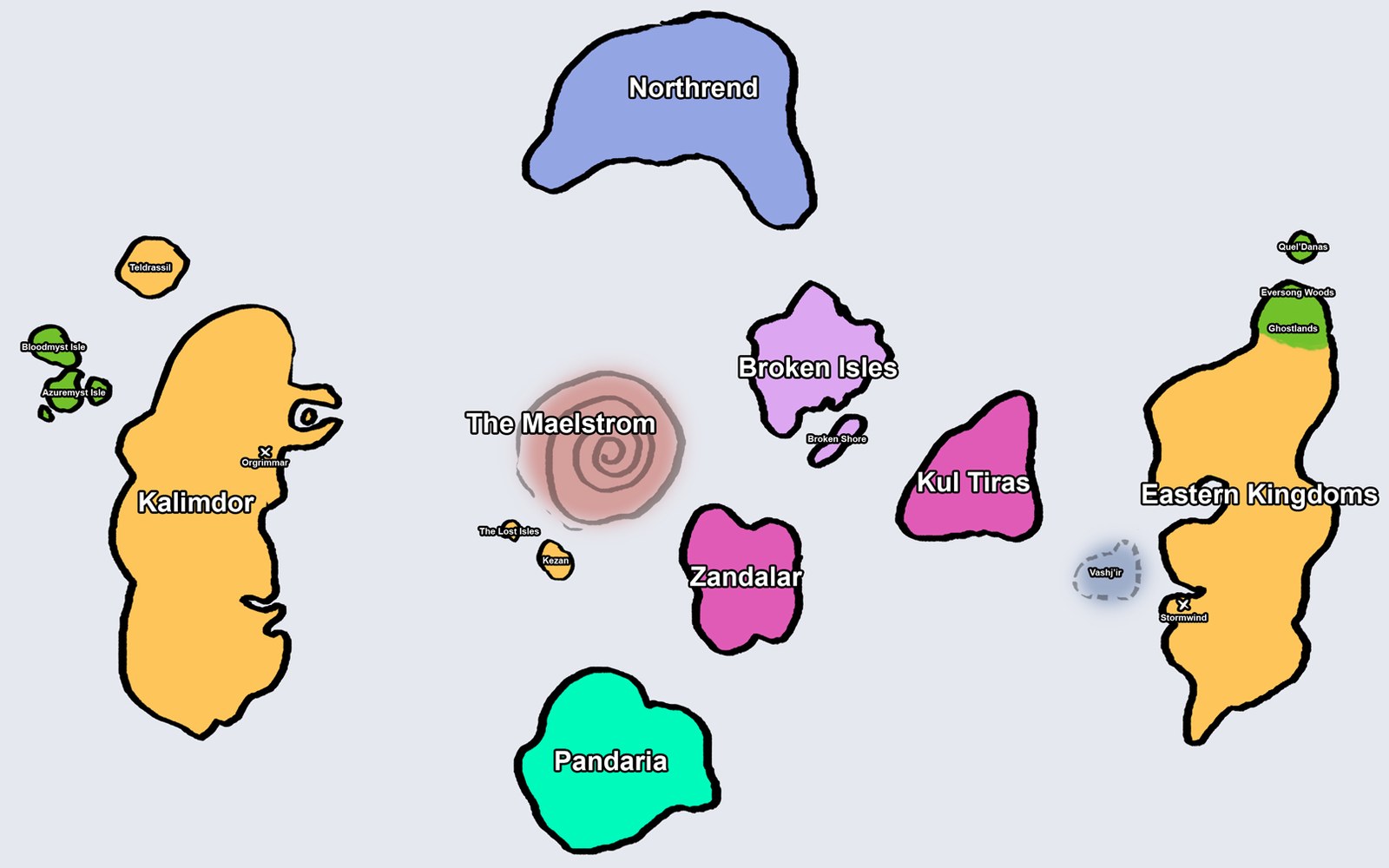
Ten expansions on a shelf. Blizzard’s most successful answer to all of them was the 2004 build, reissued.
Photo: Azeroth in World of Warcraft 2021 · Wikimedia Commons
Outland replaced the open continent with a sequence of gated zones. Every expansion since has argued about how linear to be.
Photo: Rodrigo Arrosquipa / Pexels
The Architecture of a Funnel
When The Burning Crusade launched on 16 January 2007, it became the fastest-selling PC game in history at that point, moving roughly 2.4 million copies in a single day. Players stepped through the Dark Portal and into Hellfire Peninsula, a blasted rust-red killing field with one road in and one road forward. That was not an accident of art direction. It was a structural statement: the expansion would move players through zones in a defined sequence, each one unlocking the next, each one keyed to a reputation grind with a distinct faction.
The original 2004 launch had offered a messier, more lateral world — contested zones, overlapping level bands, multiple paths to the same destination. Outland replaced that with a spine. Hellfire Peninsula fed into Zangarmarsh, which fed into Terokkar Forest, which fed into Nagrand and the Blade's Edge Mountains. Players could drift sideways, but the content gravity always pointed forward. By the time they reached Netherstorm and Shadowmoon Valley, they were 70 and queuing for heroic dungeons.
- 16 January 2007The Burning Crusade launches; ~2.4 million copies sold in the first 24 hours
- 2008Wrath of the Lich King extends the corridor model with phasing technology
- 2014Warlords of Draenor garrison widely seen as the corridor's most isolating expression
- 2022Dragonflight introduces dragonriding as a structural answer to linear zone traversal
The faction reputation system reinforced the corridor. Cenarion Expedition, Lower City, Sha'tar, Violet Eye — each one gated a meaningful reward behind a reputation grind that took weeks. Flying was locked behind Artisan Riding's gold cost. Heroic dungeon keys required Honored standing with the relevant faction. The expansion was not just linear spatially; it was linear temporally, dispensing access on a schedule whether players wanted that or not.
What the Corridor Solved, and What It Invented
The design solved a genuine problem. Vanilla's open structure produced wildly uneven content consumption: players stumbled into zones above their level, skipped questlines, arrived at endgame unprepared. The Burning Crusade ensured almost every levelling player saw almost every zone's story, built up the correct gear baseline, and emerged at 70 ready for Karazhan. Blizzard's design control over the player journey increased sharply.
What it invented was a template that proved hard to escape. Wrath of the Lich King (2008) tightened the corridor further with phasing technology — the same physical space showing different states to different players depending on quest progress, which was the design framework that ultimately sent subscriber numbers to twelve million and then lost them when the content ran out. Cataclysm scattered the formula across the original continents and partially broke it. Mists of Pandaria refined the faction-reputation rhythm into daily quest hubs that became a separate controversy entirely.
BlizzCon is where the announcements land, and where several of the decisions documented on this site were first stated out loud.
Photo: Tahir Xəlfəquliyev / Pexels
The garrison in Warlords of Draenor represented the corridor's logical endpoint: players moved through the same fixed zone sequence but spent their downtime in an instanced personal base, further reducing pressure to engage with the shared world. The corridor had become a chute. Legion pulled back toward outdoor content and world quests as a corrective, but the underlying zone-sequence logic — land, hub, questline, next zone — persisted.
Every expansion team since 2007 has had to answer the same question: how much do you trust players to find the content on their own? The Burning Crusade's answer — not much — was read as paternalistic by some and as quality control by others. Dragonflight's 2022 return to a more open Dragon Isles, with its dragonriding traversal that made lateral exploration genuinely fast, represented the most direct structural pushback against the corridor design in the game's history.
None of this makes Outland a failure. The zones hold up aesthetically — Nagrand in particular remains one of the most distinctive environments Blizzard's artists ever produced. But the expansion's structural legacy is the more interesting thing: a design decision made under pressure to control player experience that calcified into genre convention, then spent fifteen years being incrementally questioned by the same studio that invented it.
- corridor design
- a zone-sequence model in which players are directed through content in a fixed order with limited lateral movement
- faction treadmill
- a reputation-grind system that gates key rewards behind cumulative standing with expansion-specific factions
- phasing
- technology that shows different states of the same zone to players at different quest stages, deepening linearity through personalisation
- heroic dungeon keys
- Burning Crusade access items requiring Honored faction standing, tying dungeon progression to the reputation treadmill