Shadowlands: Four Covenants and a Decision You Could Not Undo
The expansion that asked players to choose a faction and then quietly stopped insisting on it.
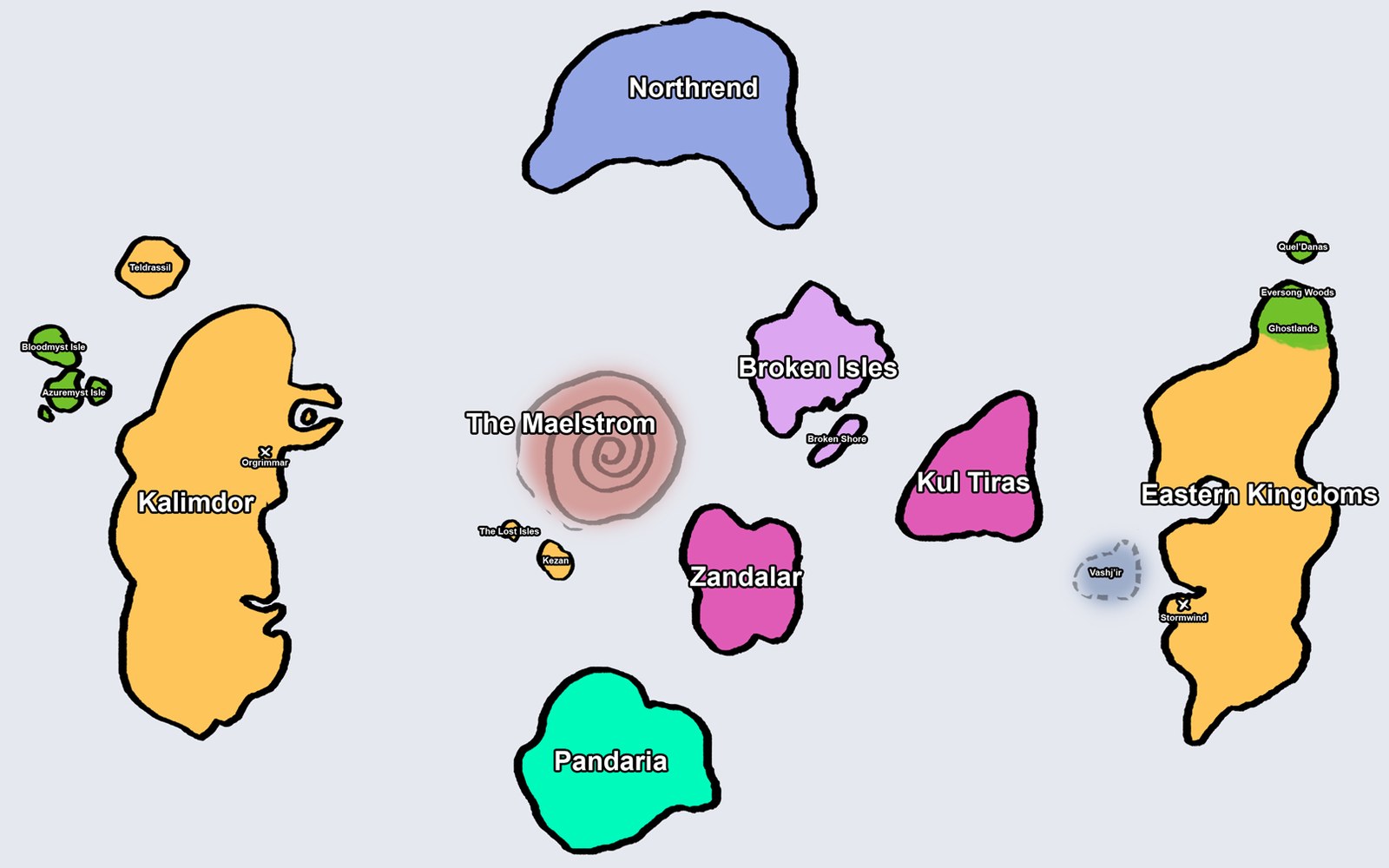
Ten expansions on a shelf. Blizzard’s most successful answer to all of them was the 2004 build, reissued.
Photo: Azeroth in World of Warcraft 2021 · Wikimedia Commons

Four Covenants, one choice, and a switching cost high enough that patch 9.1.5 had to undo it.
Photo: Sergey Platonov / Pexels
The Architecture of the Choice
Shadowlands launched on 23 November 2020 as World of Warcraft's eighth expansion, and its central design proposition was unusually legible: at max level, players chose one of four afterlife factions — Kyrian, Necrolord, Night Fae, or Venthyr — and that choice shaped everything that followed. Each Covenant delivered a unique class ability, a signature transport power, a cosmetic set, a Soulbind progression tree, and exclusive story chapters. The four realms themselves — Bastion, Maldraxxus, Ardenweald, and Revendreth — were structurally distinct zones built around those factions. The ambition was real: Blizzard wanted a decision with visible consequence, not a cosmetic preference dressed up as meaningful.
The mechanism that made the choice consequential also made it punishing. Switching Covenants was possible in principle, but the process required grinding reputation with the new faction from scratch, surrendering previously accumulated Renown rank, and forfeiting the previous Covenant's cosmetics until the player returned. In practical terms, a player who chose Night Fae and later discovered that their class performed demonstrably better under Kyrian faced weeks of catch-up work before their character was competitive again. In a game where Mythic+ scores and raid performance are used as social filters for group invitations, that gap had real consequences for how players could participate.

BlizzCon is where the announcements land, and where several of the decisions documented on this site were first stated out loud.
Photo: Tahir Xəlfəquliyev / Pexels
Community Response and the Patch Revision
The backlash formed quickly and took two distinct shapes. The first was a straightforward performance argument: Covenant abilities were not balanced against one another at launch, and for several classes the gap between the optimal choice and the suboptimal one was wide enough to affect whether a player was invited to high-end content at all. Ion Hazzikostas and the development team had publicly stated, during the beta period, that balancing Covenants perfectly was less important than making them feel thematically distinct — a position the community received with scepticism that hardened into hostility once live data confirmed the disparities. The second objection was systemic: even players unbothered by min-maxing found the penalty for changing their mind disproportionate to what the choice actually delivered narratively. Locking story chapters behind Covenant allegiance meant that a single playthrough was structurally incomplete.
The Covenant system belongs to a pattern Blizzard had already traced with borrowed power — designing an expansion-specific progression layer that generated friction as a feature, then revising it when the friction proved counterproductive. Azerite armour in Battle for Azeroth required three structural revisions before Shadowlands even launched. Covenants followed a similar arc, compressed into a single expansion cycle. Patch 9.1, which arrived in June 2021, softened the switching penalty modestly. Patch 9.1.5, which went live in October 2021, made switching effectively free — players could move between Covenants, carry their Renown progress, and access previously locked cosmetics without the prior week-long rehabilitation process. The decision that launched as permanent had become, within eleven months, reversible on demand.
- 29 June 2021Patch 9.1 (Chains of Domination); modest reduction in Covenant-switching penalties
- 26 October 2021Patch 9.1.5; Covenant switching made effectively free, Renown preserved on transfer
What the Revision Records
The post-9.1.5 Covenant system functioned essentially as a cosmetic preference layer with a side selection of class abilities — which is, critics noted, what players had been asking for before launch. The gap between the stated design intent and the shipped result, and then between the shipped result and the revised one, is the pattern worth examining. Blizzard's public position during development was that meaningful choice required meaningful commitment. The data from eleven months of live play suggested the commitment was undermining participation rather than enriching it.
Shadowlands also holds the record of launching during a period when Blizzard had already stopped publishing subscriber figures, which meant the commercial response to its design decisions remained opaque. The expansion broke simultaneous-login records at launch — the highest concurrent player count in World of Warcraft history to that point — and shed population visibly enough through 2021 that Final Fantasy XIV's overflow queues became a running news story. The Covenant revision arrived in the same quarter. Patch 9.1.5 did not state a cause. It did not need to.
- Kyrian
- Bastion; angelic faction; class ability typically strongest for several healer and caster specs at launch
- Necrolord
- Maldraxxus; undead armies faction; abilities skewed toward high-burst and tank specs
- Night Fae
- Ardenweald; nature/spirit faction; represented the most populated choice for several DPS classes
- Venthyr
- Revendreth; vampiric aristocracy; strong for certain melee specs; cosmetically the most elaborate set